Prepreg Ceramic Tapes
If you have ever made papier-mache, you already understand composite materials. You take something strong in tension: strips of paper, and something that hardens: the glue, and you combine them into a shell that neither could manage alone: a composite. Every carbon fibre part in an aircraft is that same trick, done with better ingredients. The awkward bit of papier-mache is the glue. You get too much in some places, too little in others, and it goes everywhere. Industry had exactly this problem. When you lay dry carbon fabric into a mould and wet it out with liquid resin by hand, the quality of the part depends on the patience of the person holding the brush. Too much resin and the part is heavy and weak; too little and you get dry spots that become cracks. Prepreg is the fix, and the idea is very simple: soak the fabric in the glue before it arrives at the factory, in precisely the right amount, and then stop the glue from setting by freezing.
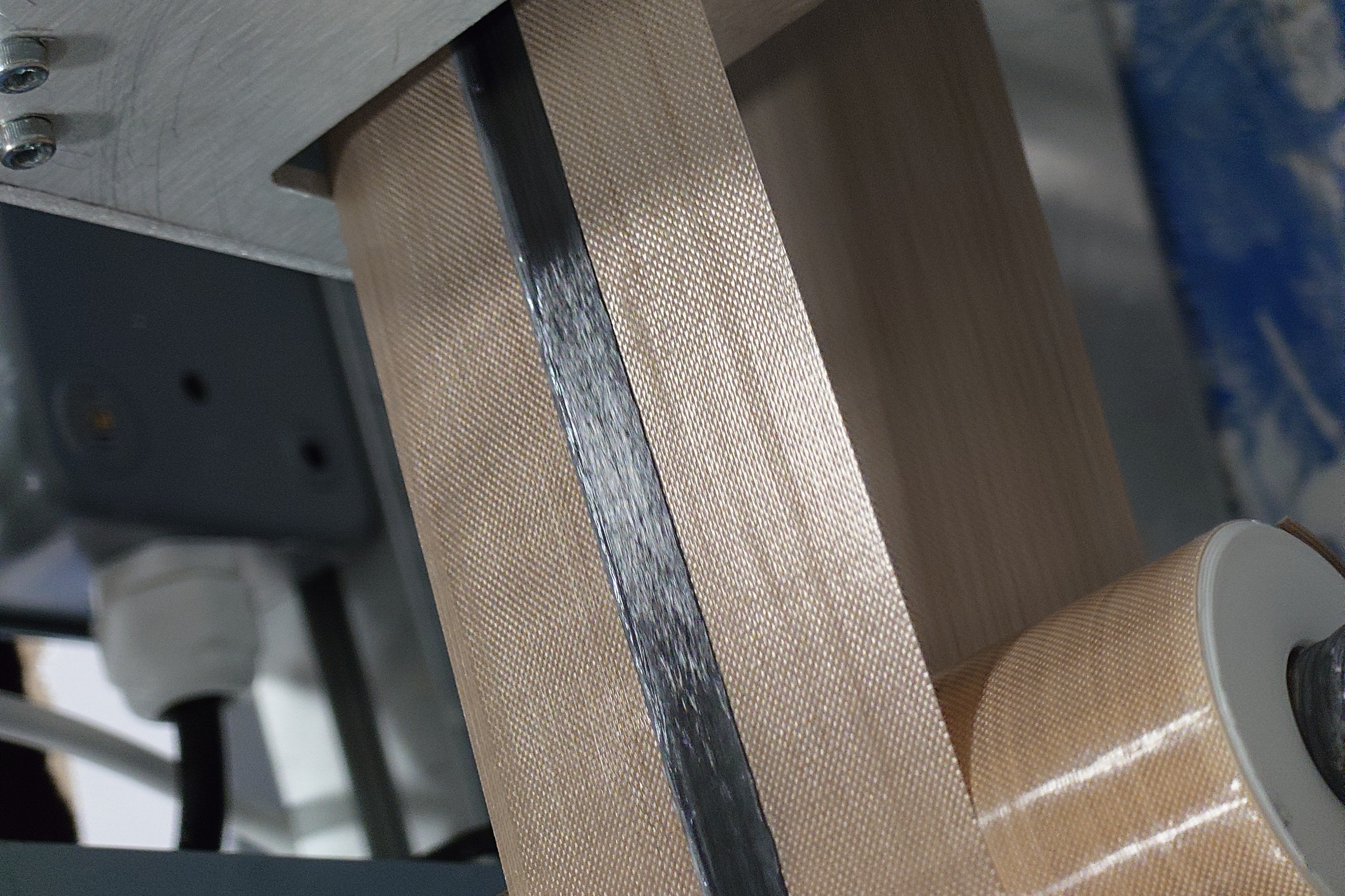
How it's made
A prepreg machine takes carbon fibres (either a woven fabric or thousands of parallel filaments spread into a flat ribbon) and marries them to a thin, carefully weighed film of resin between heated rollers. The resin is pressed into the fibres like butter into puff pastry: warm enough to flow, controlled enough that every square metre carries the same few grams of resin as every other.
Then comes the clever part. The resin is partially reacted- warmed just enough that the curing chemistry begins, then halted. Chemists call this the B-stage. A good analogy is cookie dough that has been mixed and then put in the fridge. The recipe is complete, the reaction is paused, and the dough is now a convenient, sticky, handleable thing rather than a liquid mess. Bake it whenever you like.
The finished tape goes onto a roll with a backing paper, and into a freezer, because a paused chemical reaction is only paused. At room temperature the resin slowly continues curing whether you want it to or not. This is the material's "out-life," typically a few weeks. In the freezer it keeps for a year or more.
Why it's used
When you want the best possible part, prepreg is how you get it. The resin content is set by a machine to within a percent or two, so the part comes out at the highest fibre fraction — which is to say, the most strength per kilogram. The tape is tacky, so it sticks where you place it, even on curved tooling. And because it comes as a uniform ribbon, robots can lay it: automated tape laying machines place kilometres of it to build wing skins and fuselage sections while a human watches a screen.
The limitations follow directly from the same chemistry. Freezers, out-life tracking, and expiry dates make prepreg costly to buy and costly to manage. And that paused reaction must eventually be finished under heat and pressure — usually in an autoclave, which is a pressure cooker the size of a bus. Autoclaves are magnificent and expensive, and their size sets the size of your part.
Why you don't see ceramic prepreg
So if this works so beautifully for polymers, why not do it with ceramics, which can stay strong far beyond 1000 degrees celcius?
The problem is that ceramics have no B-stage. There is no ceramic equivalent of chilled cookie dough - no state where the material is sticky, flexible, stable, and merely waiting. You can make a slurry of ceramic powder, but a slurry either stays wet or dries out; it doesn't pause. Worse, converting any ceramic precursor into actual ceramic means driving off water or organics and sintering the remainder, and the material shrinks dramatically as it does. Anyone who has watched mud dry knows what shrinkage does to a rigid body: it cracks. Wrapped around fibres that refuse to shrink with it, it cracks with enthusiasm.
Where inorganic matrices change the picture
This is why inorganic matrix composites (IMCs, built on geopolymer chemistry) are so interesting. A geopolymer resin is a water-based mineral liquid that behaves, at room temperature, remarkably like an organic resin: it wets fibres, it thickens, it has tack, it cures at temperatures a kitchen oven can reach. But what it cures into is an inorganic, ceramic-like solid that shrugs off temperatures far beyond any epoxy.
Which means the entire prepreg playbook, including the impregnation machinery, the controlled resin content, the tape laying, the tooling, the workforce that already knows how to handle sticky rolls of ribbon, transfers almost directly. You get ceramic-class temperature performance through polymer-class processing. That pairing is the whole point: a cost-effective, mature, automatable process, finally matched to a material worthy of it. Not a new factory, just better dough.