The Interphase is Everything
Last time I told you the secret of ceramic matrix composites: they are tough because part of them is deliberately weak. The boundary between fibre and matrix is engineered to fail, so cracks turn sideways and exhaust themselves instead of running clean through. But I left out the awkward question: how weak, exactly? Because there is a Goldilocks window here, and it is narrow. Bond the fibres too strongly and the crack doesn't bother turning; it cuts straight through fibre and matrix alike, and you have built an expensive teacup. Bond them too weakly and the fibres slide about uselessly in their sockets, carrying no load, and you have built a rope of loose strands wearing a ceramic coat. Everything interesting happens in the strip between those failures, and hitting it on purpose is the real art of the CMC.
A thing, not a place
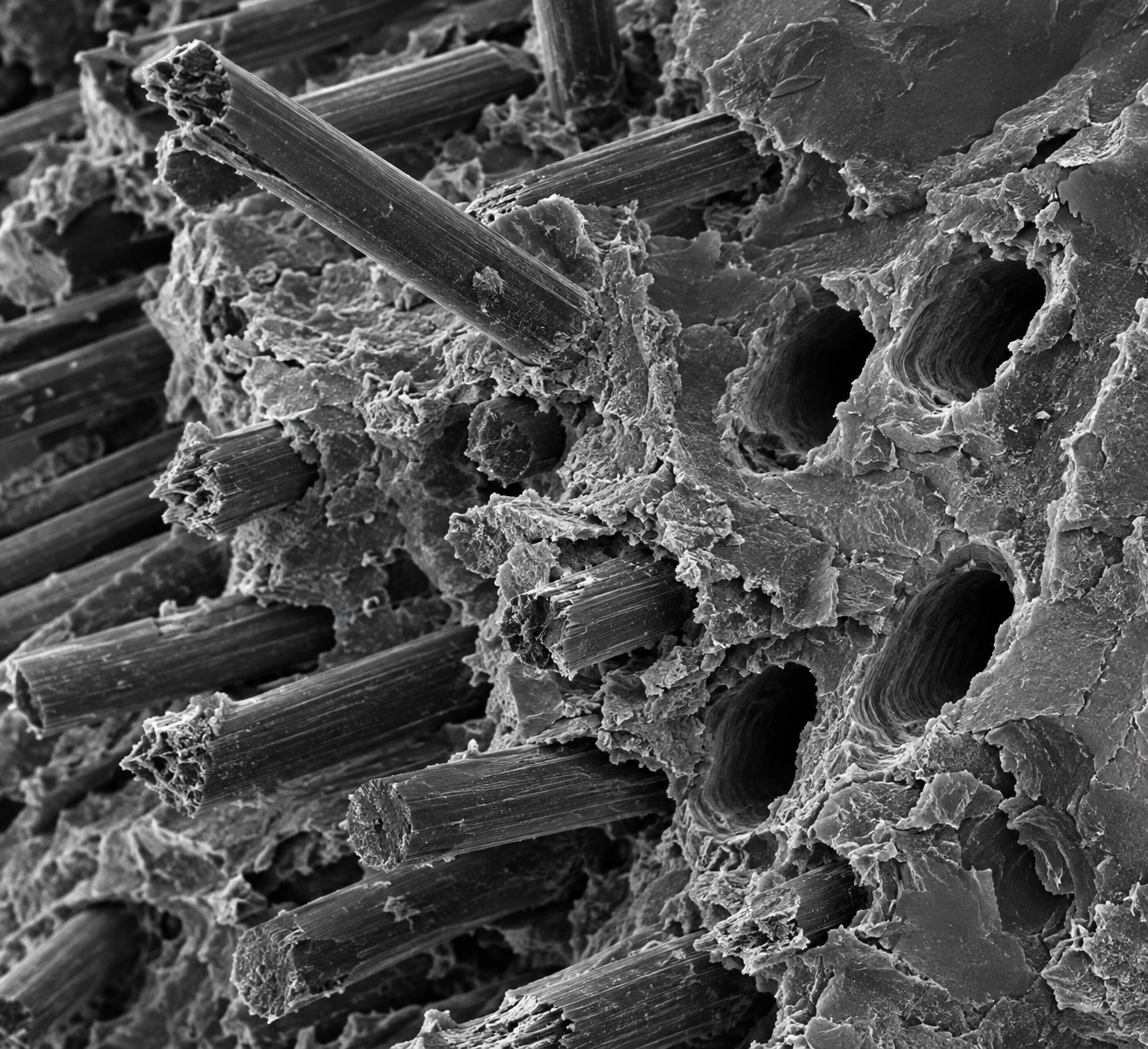
The first surprise is that the interface isn't really a boundary at all. It is a third material called the “interphase” deposited deliberately onto every fibre, a coating somewhere between a few nanometres and a micron thick. The classic choices, carbon and boron nitride, are chosen for the same reason: their crystals are layered, like a deck of cards. Within each layer the bonding is ferociously strong; between layers, the cards barely hold hands. A crack arriving at full sprint hits the deck edge-on and the cards simply slip past one another, swallowing the crack's energy in a million tiny shuffles. The most important nanometres in the whole structure.
The theory arrived before the material
In 1971, three researchers at the National Physical Laboratory, Aveston, Cooper and Kelly, sat down and worked out the mathematics of what happens when a brittle matrix full of strong fibres begins to crack: not one catastrophic fracture but many fine, harmless, evenly spaced ones, the load handed politely to the fibres each time. Their equations described, in effect, the perfect CMC. The materials that would obey those equations barely existed yet. Physics had written the recipe before anyone had even seen the material.
The happy accident
And when the material was finally built, the first great interphase was not designed at all. It was found. Around 1980, researchers reinforcing glass-ceramics with the new silicon carbide fibres noticed their composites were unaccountably, wonderfully tough — and on inspection discovered a whisper-thin carbon-rich layer that had formed itself at the fibre surface during processing, an accidental gift of the chemistry. Once its role was understood, the deliberate era began: French rocket-nozzle engineers in Bordeaux perfected the art of growing carbon and boron nitride coatings onto fibre preforms from hot gas, one atomic layer at a time, and the modern silicon carbide CMC was born.
The fuse that burns
But carbon and boron nitride share a vice: in hot air, they burn. And the whole mechanism is that under load, the matrix fills with fine cracks. Each crack is a corridor, and oxygen strolls down every one of them, finds the interphase, and quietly consumes it. The mechanical fuse is eaten away at precisely the moment it is needed. Much of the last forty years of non-oxide CMC research is one long campaign in this war: seals, coatings, and cleverest of all, matrices laced with compounds that flow into cracks and heal them shut, like blood clotting.
The oxide impasse, and a rescue from geology
The obvious dodge is to build the whole composite from oxides; things that are already burnt cannot burn. But oxides bond enthusiastically to other oxides; there is no easy weak handshake. The search for one produced my favourite detour in the field: in the mid-1990s, researchers noticed that in natural rocks, grains of the mineral monazite sit alongside alumina for geological ages without ever bonding to it. Nature had been running the experiment for a billion years, and the non-stick coatings work perfectly but they have never quite escaped the cost problem.
Relocating the weakness
So the oxide camp did something braver: they abandoned the interphase altogether and moved the weakness into the matrix itself. Make the matrix porous and slightly crumbly, using a mortar that deliberately never quite sets hard, and a crack finds no single highway, just a maze of dead ends everywhere it turns. Nature, incidentally, approves: mother-of-pearl is 95 per cent brittle mineral, made thousands of times tougher than chalk by nothing more than weak seams in the right places.
Two tribes
And that is where the family splits. Non-oxide CMCs: strong matrix, engineered interphase, the highest performance we know how to make, and an eternal war with oxygen. Oxide CMCs: weak matrix, no interphase at all, utterly indifferent to hot air, and a lower ceiling. Neither is better; they are two answers to the same Goldilocks question, which is why a turbine's innards and an exhaust structure make different choices. And it is the first question any new matrix must answer (including the inorganic polymer matrices) nevermind the chemistry, what do you do at the fibre surface?