Inorganic Polymers
A polymer, at heart, is just a paper chain. You take one small molecule, link it to another, link that to another, and keep going until you have something long and tangled enough to be useful. Everything we call plastic works this way, and nearly all of it is built from chains of carbon, which is why it burns, softens in the sun, and gives up entirely above a few hundred degrees.
But here is a question worth asking: does the chain have to be carbon? The Earth's crust is mostly silicon, aluminium, and oxygen, and those atoms link into networks quite happily, after-all that's what rock is. So could you make a material that processes like a plastic- poured, moulded, cured in an ordinary oven- but is built like a stone? You can. These are inorganic polymers, and their story is one of the odder ones in materials science.
Two inventors, one idea
The idea grew up twice, on opposite sides of the Iron Curtain, and for opposite reasons. In 1950s Kyiv, the Soviet-Ukrainian researcher Viktor Glukhovsky was studying why Roman and Egyptian constructions had outlasted everything built since. His conclusion was that certain ancient binders resembled natural minerals more than modern cement does, and he showed you could recreate the effect: take powdered aluminosilicate rock, mix it with a strong alkaline solution, and it hardens into an artificial stone. He called these materials "soil silicates" and "soil cements," and his successors in Kyiv (notably Pavel Krivenko) carried the work into buildings, railway sleepers, and eventually national standards.
In 1970s France, Joseph Davidovits arrived at the same chemistry from a completely different direction. A series of deadly fires had made flammable plastics a public scandal, and Davidovits went hunting for a polymer that simply could not burn. He found it in the same alkali-activated aluminosilicates, recognised that their structure was genuinely polymeric, resembling zeolite minerals, and in 1978 gave the family the name that stuck: geopolymers.
For decades the two schools worked a continent and an ideology apart, and it took the collapse of the Soviet Union to bring them into one room: at the first international conference on alkaline cements in Kyiv in 1994, Glukhovsky opened the proceedings and Davidovits presented his geopolymer cements. Even then, the vocabulary stayed contested. Davidovits guards his word closely- a geopolymer, on his definition, is a true polymer of quite specific structure, and much of what everyone else makes he files under mere "alkali-activated materials," a distinction he polices with some vigour. Which is one reason I prefer the roomier phrase in my title: an inorganic polymer is simply any polymer that manages without carbon, and under that tent there is space for everybody. Later researchers, particularly the Melbourne school of van Deventer, Provis, and Duxson, and Waltraud Kriven's group in Illinois, turned the new materials into deeper science.
What actually happens in the mixture
The reaction is easier to picture than to pronounce. Start with a fine aluminosilicate flour like calcined clay (metakaolin), fly ash from power stations, or ground furnace slag. Stir it into a fiercely alkaline liquid, typically sodium or potassium silicate. The alkali is a demolition crew: it strips silicon and aluminium atoms out of the powder and sets them loose in solution. Floating free, these fragments find one another and click back together; first into small clusters, then into an endless three-dimensional network of silicon–oxygen–aluminium bonds, with the sodium or potassium tucked into the gaps to balance the books.
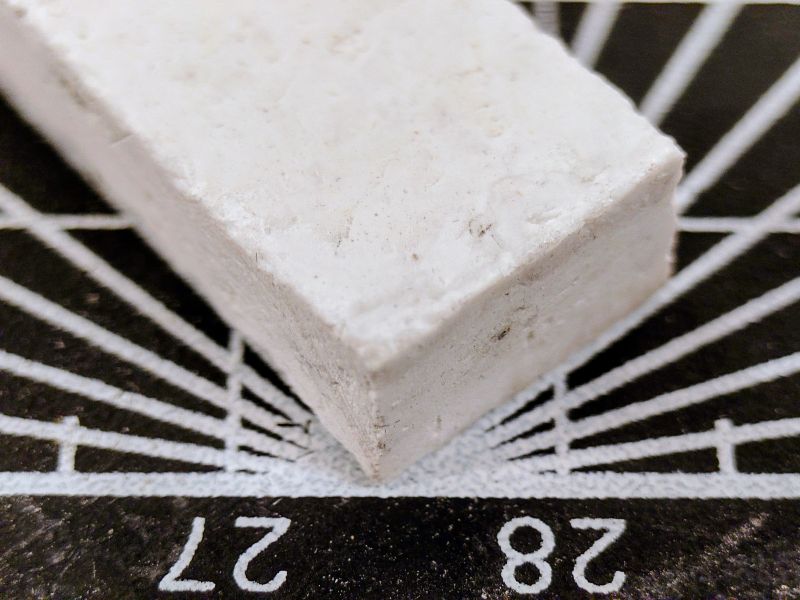
You have dissolved a rock and let it reassemble as a different rock; one shaped like your mould. No kiln, no clinker, no thousand-degree firing. The whole thing happens at temperatures a domestic oven considers a warm afternoon, and the product doesn't burn, because there is no carbon in it to burn.
So where are the prepregs?
Given my enthusiasm for prepreg tape in a previous post, you might expect geopolymer prepregs to be on the market. They are not, and the reasons are informative.
First, water. In an epoxy, the liquid is the future solid. In a geopolymer resin, water is both the solvent and a participant in the chemistry: let it evaporate and the reaction is ruined; seal it in and the tape stays wet and heavy. Second, there is no natural pause button. Epoxy has its B-stage, that chilled-cookie-dough state where the reaction waits politely in a freezer. Geopolymerisation, once begun, creeps onward; the out-life is measured in hours or days, not months. Third, the resin is strongly alkaline, which complicates every roller, backing film, and pair of hands it meets. And fourth, honestly, nobody was asking: the field grew up in civil engineering, where the customer wants concrete by the truckload, not ribbon by the roll. None of these is a law of physics. They are engineering problems: formulation, stabilisation, handling. Exactly the kind that epoxy chemists solved for their own materials in the 1950s.
Why this might matter enormously
Materials science has long had a gap in the middle of it. Polymers are cheap and easy to shape but die young in heat. Ceramics shrug off heat but must be fired, slowly and expensively, and hate being large or complicated. Inorganic polymers sit precisely in the gap: shaped like a polymer, surviving like a ceramic, made from some of the most abundant elements on the planet, with a fraction of cement's carbon footprint thrown in. A seventy-year-old idea, developed to explain the pyramids and to stop plastics burning, may turn out to be the processing route that finally makes high-temperature materials ordinary. The chemistry is ready. The prepreg machine is waiting.