Hot, Light, Cheap: Pick Three
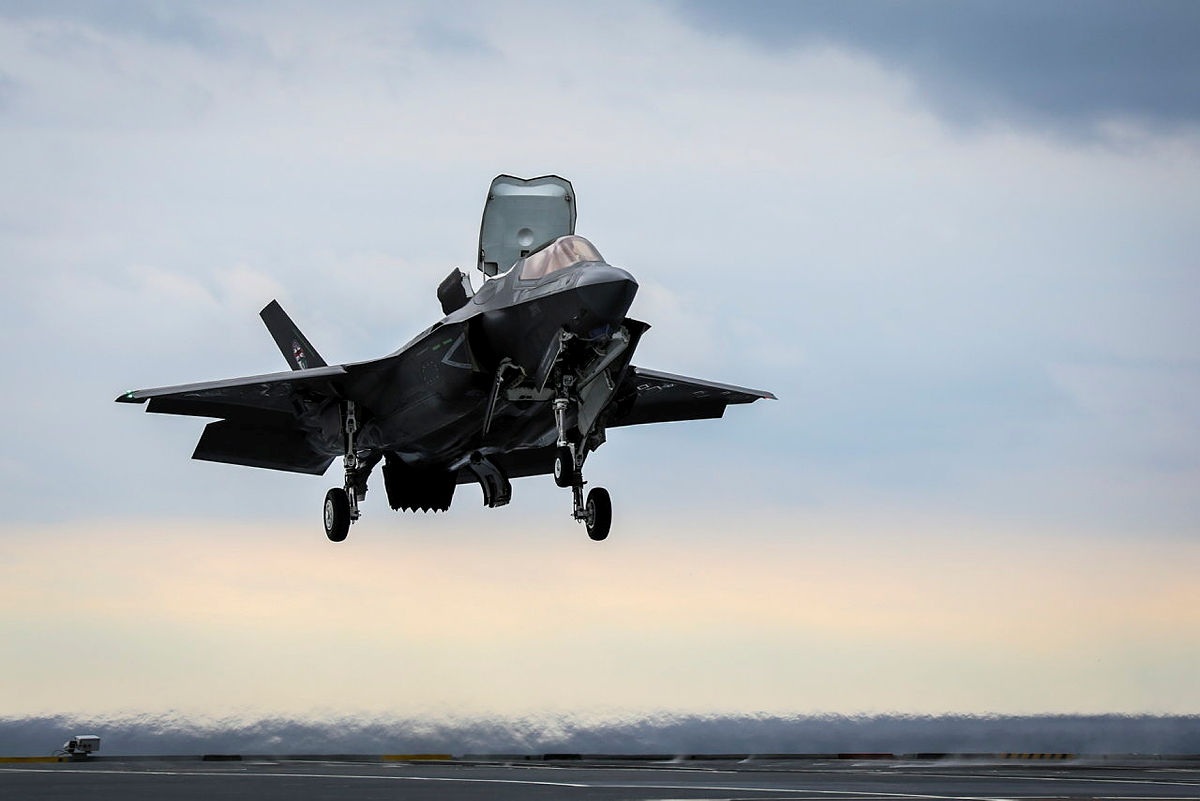
Standing on the grass at Farnborough airshow with a friend from the National Composites Centre, I watched an F-35 hover on its own exhaust. It is an astonishing thing to see. One of the most advanced aircraft ever built, hanging on a column of air, and yet the conversation between us was the same conversation composites engineers have been having for twenty years. Ceramic matrix composites are the future of the hot section. They were the future when I was a student. They were the future when my friend was a student. So why does it never quite arrive?
I think I know why, and this essay is my attempt at an answer. Here is the thesis in one sentence: for twenty years the question was "how hot?" The next decade belongs to materials that are hot, light, and cheap. Two out of three will no longer be enough. Every engineer knows the old project-management triangle “good, fast, cheap; pick two”. Materials for hot structures obey their own version, and it is worth seeing clearly that every family we have is a corner-cutting compromise. Superalloys are hot and affordable, but heavy. Polymer composites are light and cheap, but melt. Ceramic matrix composites are hot and light, but priced like jewellery. The whole history of the field is a walk around the edges of this triangle, and the rest of this essay walks it deliberately: one corner at a time.
Hot: the corner we already conquered
The jet engine has been constrained by its hottest materials since the days of Whittle, and for fifty years the nickel superalloys carried it, pushed along by the great achievements of metallurgy: single-crystal blades, ceramic coatings, and increasingly complex internal cooling. But somewhere in the 1990s the metal itself ran out of road; superalloys were operating within a hundred degrees of their own melting points, and no amount of chemistry can push past that. Ceramic composites are the answer. They run hundreds of degrees hotter than any metal, and they are flying today in commercial engines. But here is the insider's footnote to that story, and it matters for what follows. The real prize of a hotter material was never simply a hotter flame. A superalloy blade survives by taking air stolen from the compressor, which the engine worked hard to squeeze and then sprays through the blade instead of using it to make thrust. Every degree of extra material capability hands some of that stolen air back to the cycle. That is where temperature delivers: in efficiency. And it is also why I say the "how hot" era is closing; not because heat stopped mattering, but because the industry now assumes it. Beyond a point, ever-higher temperature capability became a spec-sheet arms race: numbers that win conference presentations rather than orders. Hot is no longer the differentiator. Hot is the entry fee.
Light: the corner that multiplies
The second corner is easier to state and harder to overstate. A CMC is roughly a third of the density of the superalloy it replaces, and in something that flies, saved weight is compound interest. A lighter turbine part spins in a lighter disc, held by a lighter shaft, in a lighter casing, lifted by a wing that can now be lighter too; the engineers call it the weight spiral, and it is the reason a kilogram removed from the hot end is worth many kilograms removed from the fuselage. Lightness, unlike temperature, never stops paying. But polymer composites are light too, and far cheaper; lightness alone never sold a CMC. It is a necessary corner, not a sufficient one.
Cheap: the corner nobody has reached
And so to the corner where the future has been getting stuck. Aerospace-grade CMCs have remained confined to flagship engine programmes. Yes, the parts fly, but only where a national engine programme can absorb the bill. Why? The instinctive answer is raw material costs, but that answer is wrong, or at least incomplete. The cost of a CMC part is a system cost, and the system is brutal. The fibre is expensive, yes. But the process routes are slow in ways that are hard to convey politely: chemical vapour infiltration grows the matrix into the fibre preform atom by atom from hot gas, over weeks, in machines that cost like small ships. Alternative routes need multiple impregnation-and-fire cycles, each one a day and a kiln-load of energy. Yield does the rest; scrap a part at the end of a six-week process and you have not lost a part, you have lost six weeks of a furnace. Cycle time, capital, energy, yield, powder cost: multiply them together and the raw material almost disappears into the noise.
Which is why the number that actually gates adoption is not strength, not temperature, and not cost per kilogram of powder. It is cost per part, at rate, ie what does the thousandth part cost when the line is running? Until that number falls into the territory a Tier 1 supplier can quote against, CMCs stay where they are: magnificent, and rare.
The gap, and my prediction
Now zoom out, and look at what the triangle has left us. Down at one end sit the polymer composites, light and cheap, good to perhaps two hundred degrees. Up at the other sit the CMCs, hot and light, earning their keep above a thousand. In between lies eight hundred degrees of clear water with no composite in it at all.
I can hear the objection: the gap is not empty, titanium and steel and the lower nickel alloys have lived there for a century. Indeed. The gap is not unoccupied; it is occupied by metal, which is the problem. Every structure in that band, including exhausts, nacelles, heat shields, engine surrounds, hypersonic skins all pay the full metal weight penalty for want of a composite that can stand the temperature. The gap is not a vacancy. It is a tax.
Here is my prediction: the next decade of high-temperature structures belongs to multilayer material systems; structures that are not one material but a deliberate stack, graded from cheap and light where it is cool to ceramic where it is hot. And the reason I am confident is that the enabling material for such stacks already exists. Inorganic matrix composites- the geopolymer-derived materials I will be circling in this series- sit natively in the middle of the gap, with ceramic-class temperature tolerance and polymer-class processing. But their real trick is more specific than that: because they cure like a polymer and perform like a ceramic, they can be co-moulded with both neighbours. Laminate an IMC layer onto a polymer composite and you have given an OMC structure a heat shield it could never otherwise wear. The OMC invades the gap from below. Pair an IMC with a CMC and you can build the cooler regions of a "ceramic" structure at a fraction of full-CMC cost. The CMC is relieved from above, reserved for the metres that truly need it. And because the layers are moulded together rather than bolted together, the stack sidesteps the oldest curse of mixed-material design: the joint. Dissimilar materials fastened together fight at every interface; thermal mismatch, drilled holes, sealants, inspection. Materials cured into one another do not. Attack the gap from both ends at once, and the gap closes. Hot, light, and finally cheap. All three corners. That is the thesis.
What comes next
These essays will lay the groundwork one piece at a time: the tapes, the matrices, the fibres, the interphase, the oxidation ledger. What comes next is the practical series of how you actually build in this eight-hundred-degree gap: what an IMC laminate looks like, what it can and cannot yet do, and what it will take to turn cost-per-part-at-rate from a phrase in this essay into a number on a quotation. The future of composites has been hovering over the airfield long enough. Time to land it.